
Is OpenAI Already Dead?


First, market share. OpenAI had an enormous first-mover advantage, but it’s been losing ground quickly. Depending on how you measure it, it’s gone from roughly 86% to closer to 65% in traffic share. That’s still dominant, but the direction matters more than the absolute number.
Second, the business model shift. By OpenAI’s own admission, advertising is a last-resort model. That puts them directly in competition with Google, a company that has been refining advertising for over 20 years.
“I kind of think of ads as like a last resort for us as a business model. I would do it if it meant that it was the only way for us to get everybody in the world access to great services … but if we can find something that doesn’t do that, I prefer that.”
— Sam Altman, October 2024
That’s not a position of strength. That’s a concession.
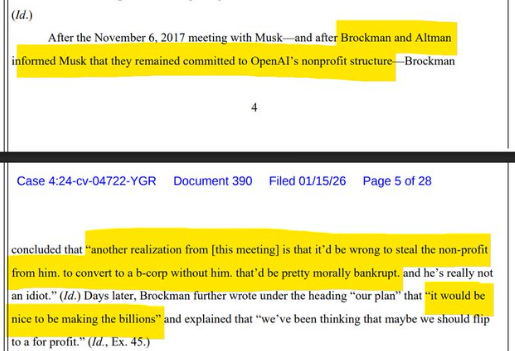
Third, the legal overhang. The ongoing case with Elon Musk is not noise. Based on current betting markets, Musk is favored to win at roughly 61% on Kalshi. I’m not a lawyer, but having read some of the recently released messages, it’s hard to ignore how damaging they look. At minimum, this introduces uncertainty at the worst possible time.
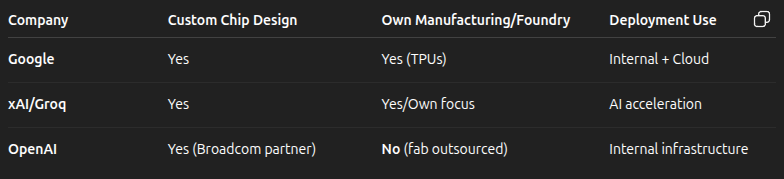
Fourth, competition is converging. Google isn’t just competing at the model level, it’s competing at the infrastructure level with its own chips. xAI is doing the same. Meta is involved. This isn’t just about better models anymore. It’s about vertical integration and control of the full stack.
Finally, OpenAI may have missed key platform moments. Video, coding, and software development are fragmenting into specialized tools and workflows. That fragmentation chips away at the value of a single, general-purpose model over time.